


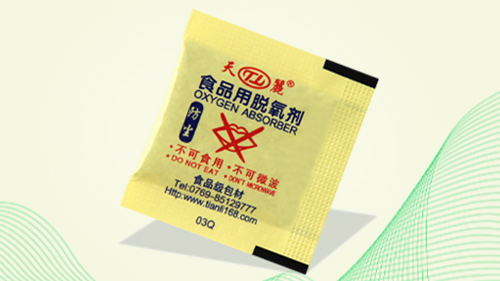
DeoxidizerIt is widely used in food packaging to extend the shelf life of food and maintain its quality by removing oxygen from the packaging. However, temperature and humidity are important factors affecting the effectiveness of deoxidizers. Below, the author will provide a detailed explanation of the impact of temperature and humidity on the performance of deoxidizers, analyze the reasons, and propose corresponding solutions to ensure that deoxidizers can function effectively under different environmental conditions.
The influence of temperature on the effect of deoxidizers
Temperature is a key factor affecting the performance of deoxidizers. The working principle of deoxidizers mainly involves removing oxygen from the packaging through chemical reactions or physical adsorption. The rates of these reactions and adsorption processes are affected by temperature changes.
Under high-temperature conditions, the chemical reaction rate of deoxidizers usually accelerates. For instance, iron-based deoxidizers absorb oxygen through the oxidation reaction of iron powder. High temperatures will accelerate this oxidation reaction, causing the deoxidizer to be consumed rapidly within a short period of time. If the temperature is too high during storage or transportation, the service life of the deoxidizer may be shortened, as its active reactants are exhausted prematurely, resulting in oxygen not being effectively absorbed during the remaining packaging cycle.
On the other hand, a low-temperature environment will slow down the reaction rate and adsorption capacity of deoxidizers. The lower the temperature, the slower the rate of chemical reactions, which will reduce the efficiency of the deoxidizer in removing oxygen, especially in the initial stage of packaging. In this case, food may be exposed to oxygen for a longer time, increasing the risk of oxidation and deterioration.
The influence of humidity on the effect of deoxidizers
Humidity is also an important factor affecting the effectiveness of deoxidizers. The humidity level inside the packaging will affect the physical adsorption capacity and chemical reaction process of the deoxidizer.
Excessive humidity can cause deoxidizers to deliquesce, clump or become ineffective. For instance, iron-based deoxidizers will absorb moisture in high-humidity environments, forming iron oxide hydrates, which reduces their direct contact area with oxygen and thereby lowers their deoxidation capacity. In addition, some deoxidizer components, such as sulfites, are prone to decomposition by water under high humidity conditions, which affects their deoxygenation effect.
However, moderate humidity is necessary for some deoxidizers, such as peroxide deoxidizers. They need a certain amount of moisture to undergo oxygen reactions. If the humidity is too low, these reactions may not proceed effectively, thus preventing oxygen from being fully absorbed. Therefore, during the use of deoxidizers, it is necessary to strictly control the environmental humidity to ensure their effectiveness.
Problems and solutions in practical applications
In practical applications, to ensure that deoxidizers work effectively under various temperature and humidity conditions, a series of measures need to be taken.
Firstly, in high-temperature environments, the temperature during storage and transportation should be reduced as much as possible to prevent the deoxidizer from failing prematurely. For areas with high storage temperatures, insulation materials or refrigeration equipment can be used to control the temperature and ensure that the deoxidizer operates within an appropriate temperature range.
Secondly, in a high-humidity environment, moisture-proof measures should be taken to prevent the deoxidizer from getting damp and becoming ineffective. For instance, desiccants can be placed inside the package and used in combination with deoxidizers to ensure the control of humidity. In addition, using high-barrier packaging materials with moisture-proof functions, such as aluminum foil bags or coated paper bags, can effectively isolate external moisture and protect the activity of deoxidizers.
Thirdly, for low-temperature environments, the reactivity of the deoxidizer should be taken into account, and products that still have efficient deoxidation capabilities at low temperatures should be selected. For instance, some compound deoxidizers have a wider range of temperature adaptability and are suitable for use under low-temperature conditions. In addition, the reaction rate at low temperatures can be enhanced by increasing the dosage of deoxidizers or using activators.
Finally, during the packaging design and production process, reasonable selection of deoxidizers and environmental control should be carried out based on the actual environmental requirements and circulation conditions of the product. For instance, for food that is to be frozen for a long time, deoxidizers with strong low-temperature adaptability can be selected and used in combination with moisture-proof packaging materials. For the storage and transportation of food in high-temperature and humid areas, heat insulation and moisture-proof measures can be taken, and deoxidizers with wide adaptability can be selected.